Question 1
Supreme Court on Reservation After Conversion
By Rakesh Kushwaha, Lead Tech & Exam Analyst
Polity & Governance
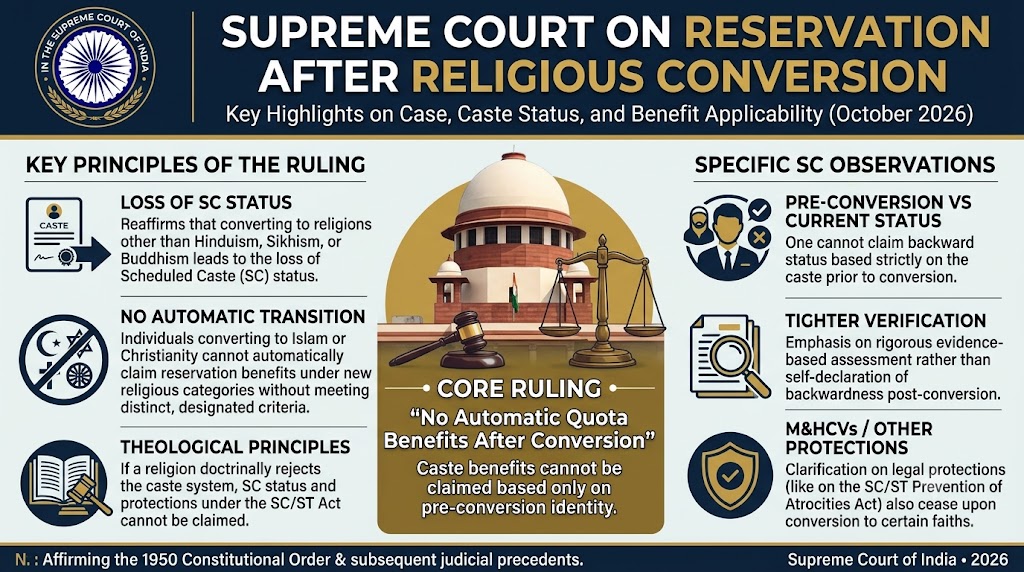
The Supreme Court of India clarified the legal relationship between religious conversion, community identity and reservation eligibility. It held that a person converting from Hinduism to Islam cannot automatically claim reservation under a notified Backward Class (Muslim) category solely on the basis of their previous caste or community status.
Why Is It in News?
On 15 October 2026, the Supreme Court upheld the Madras High Court’s decision striking down a Tamil Nadu government order that allowed certain individuals from existing backward communities to obtain Backward Class (Muslim) community certificates after converting to Islam. The case concerned the eligibility of a convert seeking recognition as a member of the Muslim Labbai backward-class community. <Cite refs={["turn608506search1","turn608506search7"]}/>
About
The judgment in State v. Sameer Ahamed N. addresses the eligibility requirements for caste- and community-based reservation following religious conversion.
A Bench comprising Justice Prashant Kumar Mishra and Justice Shree Chandrashekhar dismissed the Tamil Nadu government's appeal and upheld the invalidation of Government Order G.O. (Ms.) No. 314, dated 9 March 2024.
Key aspects of the ruling include:
- No automatic transfer of community status: Conversion to Islam does not, by itself, make a person a member of a particular notified Muslim Backward Class community.
- Independent eligibility requirements: A claim to reservation under Article 16(4) of the Constitution must satisfy the applicable constitutional and legal requirements for membership of the relevant backward class.
- Community certificates: A certificate recognises a legally established status; it cannot independently create eligibility that does not otherwise exist.
- Role of public authorities: The determination of statutory community status is a public function and cannot be conclusively delegated to a private religious organisation.
- Scheduled Caste status: Paragraph 3 of the Constitution (Scheduled Castes) Order, 1950 restricts Scheduled Caste recognition to persons professing Hinduism, Sikhism or Buddhism, subject to the applicable legal framework.
- Constitutional provisions: Article 14 concerns equality before the law, Article 16(4) enables reservation for inadequately represented backward classes in public employment, and Article 25 protects freedom of conscience and religion.
The ruling is specifically concerned with the legal requirements for claiming membership in a notified backward class after conversion. It should not be interpreted as meaning that every person who changes religion automatically loses every form of reservation or welfare eligibility; the applicable category and legal provisions matter.
Key Points
- Institution: Supreme Court of India.
- Case: State v. Sameer Ahamed N.
- Judgment date: 15 October 2026.
- Bench: Justice Prashant Kumar Mishra and Justice Shree Chandrashekhar.
- State involved: Tamil Nadu.
- Government order: G.O. (Ms.) No. 314, dated 9 March 2024.
- Main issue: Eligibility for Backward Class (Muslim) reservation after conversion to Islam.
- Article 14: Equality before the law.
- Article 16(4): Reservation for backward classes inadequately represented in public services.
- Article 25: Freedom of conscience and religion.
- Constitution (Scheduled Castes) Order, 1950: Specifies the religious eligibility conditions for Scheduled Caste recognition.
- Key principle: Religious conversion alone does not automatically confer membership of a notified backward-class community.
Test your knowledge
Try these questions from this current-affairs topic.
Question 2
Which case was associated with the Supreme Court's October 2026 ruling on reservation after conversion?
Continue practicing
6 more questions available in the Quizovers app.