Question 1
NITI Aayog Releases Data Centre Evaluation Framework
By Rakesh Kushwaha, Lead Tech & Exam Analyst
Science & Technology
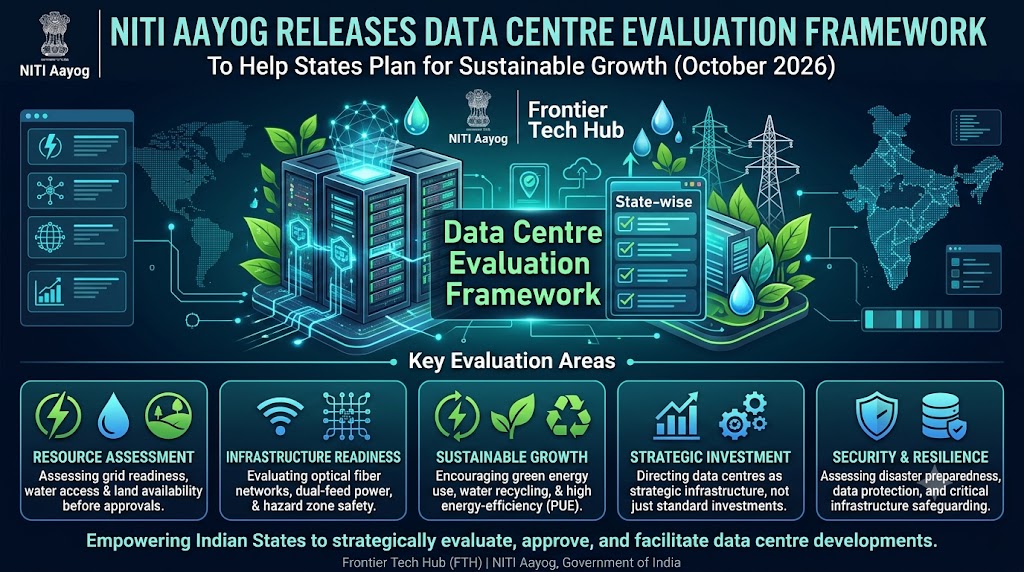
NITI Aayog’s Frontier Tech Hub has released a framework to help states evaluate data-centre proposals before approving investments. It emphasises electricity and water availability, infrastructure readiness, environmental sustainability and measurable economic benefits.
Why Is It in News?
NITI Aayog’s Frontier Tech Hub released the Data Centre Evaluation Framework to Help States Plan for Sustainable Growth on 14 October 2026. The framework was designed to help state governments assess data-centre projects more systematically and balance investment opportunities with resource constraints and long-term public benefits. <Cite refs={["turn928917search0","turn928917search3"]}/>
About
A data centre is a facility that houses computing, storage and networking equipment used to process, store and distribute digital information. Data centres are important for cloud computing, artificial intelligence, digital services and data infrastructure.
However, large data centres can require substantial electricity, water, land and supporting connectivity. NITI Aayog’s framework provides a common approach for states to evaluate proposed projects.
The framework focuses on five broad pillars:
- Power and energy: Assess electricity demand, grid capacity, reliable supply and the need for infrastructure upgrades.
- Water and resource sustainability: Evaluate water availability, local water stress, reuse, rainwater harvesting and wastewater treatment.
- Land and infrastructure readiness: Examine land suitability, connectivity, utilities, clearances and expansion capacity.
- Economic and strategic value: Assess local employment, procurement, skill development and the economic value created relative to public incentives.
- Policy, governance and implementation: Clarify responsibilities, approval processes, project conditions and monitoring arrangements.
The framework also recommends time-bound digital single-window systems for approvals, clear accountability for project commitments and incentives linked to measurable outcomes.
It is intended as a decision-support framework for state governments, rather than a single automatic approval mechanism. States can use it to identify infrastructure gaps and assess whether a project is likely to deliver sustainable economic value.
Key Points
- Institution: NITI Aayog.
- Developing unit: NITI Aayog’s Frontier Tech Hub.
- Framework: Data Centre Evaluation Framework to Help States Plan for Sustainable Growth.
- Release date: 14 October 2026.
- Primary users: State governments.
- Main purpose: Evaluate data-centre proposals and support sustainable growth.
- Key concerns: Electricity, water, land, connectivity, environmental impact and economic value.
- Five broad pillars: Power and energy; water and resource sustainability; land and infrastructure readiness; economic and strategic value; policy, governance and implementation.
- Recommended administrative approach: Digital single-window approvals and clear accountability.
- Main significance: Align data-centre investment with infrastructure readiness, resource sustainability and measurable public benefits.
- Important distinction: The framework guides state-level evaluation; it is not itself a blanket approval for data-centre projects.
Test your knowledge
Try these questions from this current-affairs topic.
Question 2
Which division of NITI Aayog developed the Data Centre Evaluation Framework?
Continue practicing
6 more questions available in the Quizovers app.