Question 1
India’s Ramsar Site Network Expands to 103 with Addition of Sukhna Wetland and Sauj Jheel
By Rakesh Kushwaha, Lead Tech & Exam Analyst
Environment & Ecology
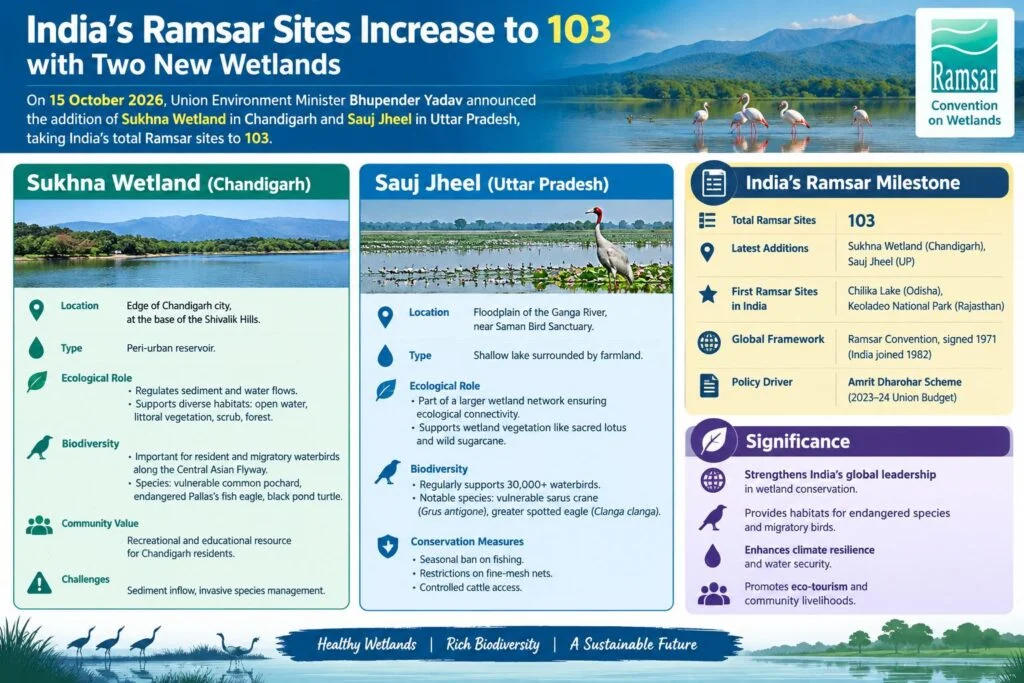
India’s network of wetlands recognised as Ramsar Sites has expanded to 103 following the inclusion of Sukhna Wetland in Chandigarh and Sauj Jheel in Uttar Pradesh. The additions strengthen India’s efforts to conserve internationally important wetlands, protect biodiversity and maintain ecological balance.
Why Is It in News?
On 15 October 2026, the Ministry of Environment, Forest and Climate Change announced that India’s Ramsar site tally had reached 103, with the addition of Sukhna Wetland (Chandigarh) and Sauj Jheel (Uttar Pradesh).
About
The Ramsar Convention on Wetlands is an international treaty adopted in 1971 in Ramsar, Iran. It provides a framework for the conservation and wise use of wetlands and their resources.
Ramsar Sites are wetlands designated as being of international importance based on ecological, botanical, zoological, limnological or hydrological significance.
The two newly added sites are:
- Sukhna Wetland: Located in Chandigarh, at the foothills of the Outer Himalayas. It supports resident and migratory waterbirds and provides important habitats along the Central Asian Flyway.
- Sauj Jheel: Located in Uttar Pradesh, it adds to the state’s network of wetlands important for biodiversity and ecological conservation.
Wetlands provide several environmental benefits, including flood regulation, groundwater recharge, water purification, carbon storage and habitats for aquatic plants and animals.
The Ramsar designation recognises a wetland’s international importance; effective conservation still depends on continued management, monitoring and protection against pollution and habitat degradation.
Key Points
- Total Ramsar Sites in India: 103.
- Announcement date: 15 October 2026.
- Newly added sites: Sukhna Wetland and Sauj Jheel.
- Sukhna Wetland is located in: Chandigarh.
- Sauj Jheel is located in: Uttar Pradesh.
- Relevant ministry: Ministry of Environment, Forest and Climate Change.
- Ramsar Convention adopted: 1971.
- Place of adoption: Ramsar, Iran.
- Main objective: Conservation and wise use of wetlands.
- Ecological significance of Sukhna: Supports resident and migratory waterbirds, including species using the Central Asian Flyway.
- Important distinction: Ramsar designation recognises international importance; it does not automatically guarantee that a wetland is fully protected from ecological threats.
Test your knowledge
Try these questions from this current-affairs topic.
Question 2
Sukhna Wetland, the newly designated Ramsar site, is located in which Union Territory?
Continue practicing
4 more questions available in the Quizovers app.