Question 1
ADB and Japan Support Green Ammonia Plant in Kakinada
By Rakesh Kushwaha, Lead Tech & Exam Analyst
Environment & Ecology
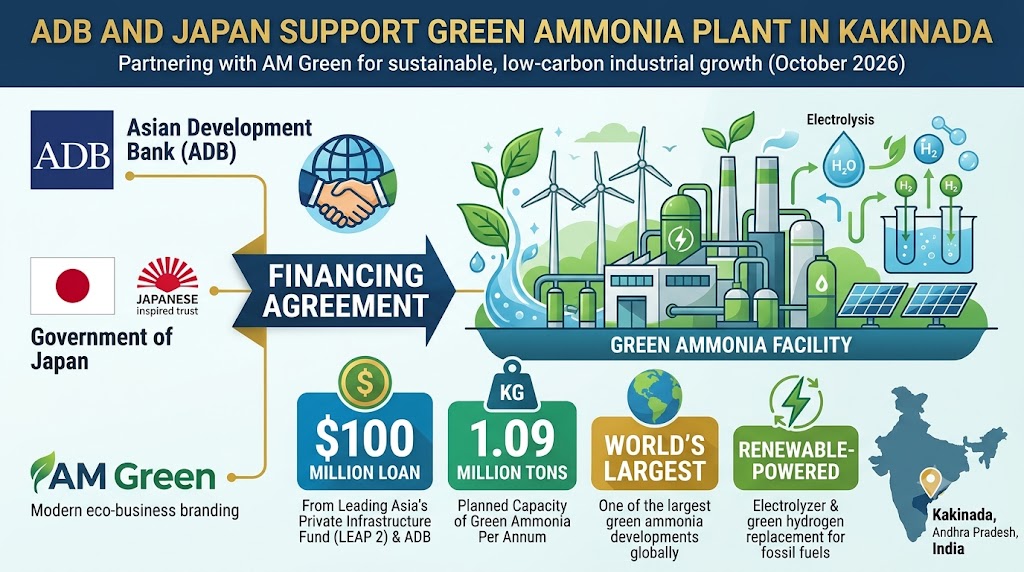
The Asian Development Bank (ADB) and the Government of Japan have signed financing agreements to support AM Green Ammonia’s renewable-powered green ammonia project in Kakinada, Andhra Pradesh. The project aims to produce ammonia with substantially lower emissions and strengthen India’s position in the emerging clean-fuels market.
Why Is It in News?
On 15 October 2026, the Asian Development Bank (ADB) and the Government of Japan announced financing agreements with AM Green Ammonia (India) Private Limited for a major green ammonia facility at Kakinada. The project is the first investment under the Action for Creating Energy Security for Long-term Resilience (ACCEL) initiative.
Fact-check: The financing announcement names ADB and the Government of Japan—not the World Bank—as the supporting institutions.
About
Green ammonia is ammonia produced using renewable energy, generally through a process in which renewable electricity helps produce green hydrogen, which is then combined with nitrogen.
Conventional ammonia production typically relies on fossil fuels, particularly natural gas, and can generate significant carbon emissions. Green ammonia offers a pathway to reduce emissions in fertiliser production and other industrial uses.
Key details of the Kakinada project include:
- Location: Kakinada, Andhra Pradesh.
- Project company: AM Green Ammonia (India) Private Limited.
- Planned production capacity: Approximately 1.1 million tonnes per year.
- Technology pathway: Renewable electricity, green hydrogen production and ammonia synthesis.
- Project development: The facility is planned at a former natural-gas-based ammonia and urea complex.
- Financing partners: Asian Development Bank and the Government of Japan.
- Programme: ACCEL, focused on long-term energy security and resilience.
The plant is planned in two phases, each with a capacity of approximately 547,500 tonnes per year. The project is expected to support cleaner industrial production and the development of export supply chains for low-carbon fuels.
Green ammonia can be used in fertilisers and has potential applications as a hydrogen carrier and a lower-carbon fuel for certain industrial and maritime uses. Its climate benefits depend on the electricity source, production process and full supply chain.
Key Points
- Project: AM Green Ammonia Project.
- Location: Kakinada, Andhra Pradesh.
- Supporting institutions: Asian Development Bank and Government of Japan.
- Project company: AM Green Ammonia (India) Private Limited.
- Planned capacity: Approximately 1.1 million tonnes per annum.
- Programme: ACCEL — Action for Creating Energy Security for Long-term Resilience.
- Product: Green ammonia.
- Main production pathway: Renewable electricity → green hydrogen → ammonia.
- Major potential use: Fertiliser production and other industrial applications.
- Significance: Cleaner ammonia production, industrial decarbonisation and potential exports.
- Important distinction: ADB is the financing institution identified in the announcement; it should not be confused with the World Bank.
Test your knowledge
Try these questions from this current-affairs topic.
Question 2
Which company is developing the green ammonia project at Kakinada?
Continue practicing
6 more questions available in the Quizovers app.